
Conspiracy Theories and the Competence Vacuum

One of the most interesting phenomena in modern society is the conspiracy theory. Even defining the concept is hard, since one person's conspiracy theory is another person's shrewd assessment of the true levers of power. Calling an idea a conspiracy theory is already a slight on the idea, the speaker derogating it merely by attaching the label. Subsequent discussion and debate often becomes emotional, with any signal getting lost in the noise. This fact, the emotionally-charged nature of conspiracy theory belief and disbelief, will be our starting point.
Because the most productive way to identify conspiracy theories isn't by evaluating them on their merits, but rather by studying the people who believe them. In doing so we find our first foothold:
Belief in conspiracy theories is largely driven by a desire for them to be true.
A believer in a conspiracy theory is motivated to lower their standard of evidence in favor of the theory because they're already disposed to believe in it. The reasons for that disposition can be many, and we'll discuss some of them, but the key is that the pre-exisiting desire exists. Like a mind virus, the conspiracy theory feeds that desire and prepetuates itself in its hosts.

The parallels to religion are obvious, so I won't belabor that point too much. The most popular religions have many of the same characteristics:
- The world is controlled by an invisible entity who brings structure, reason and justice to an otherwise cold and indifferent world.
- Those who know and follow this line of thought gain acceptance into a community of like- minded people they can trust.
- Those who don't believe are outsiders who can't fully be trusted.
Of course, it's far too reductive to say "religions are just really successful conspiracy theories". For one thing, conspiracy theories are incredibly varied, whereas to achieve broad success, religions have to file away many of their weird edges and converge on a similar set of characteristics. But more importantly, and interestingly for us, analyzing a conspiracy theory tells us precisely what its believers want and even need to be true. So let's analyze a few...
The Protocols
Perhaps the OG of conspiracy theories is The Protocols of the Elders of Zion, an antisemitic conspiracy theory created in Russia at the turn of the 20th century. It posited that world events were being controlled by a secret cabal of Jewish leaders, the supposed Elders of Zion, and the document purports to be the minutes of that cabal's meeting. In essence, the tract modernized for its time the latent antisemitism which had pervaded Europe and the Middle East for thousands of years.
The most interesting question here is "why"? Or more specifically, what latent beliefs did interested readers and converts to the theory want to believe? What explanatory desires were being exploited by the "Jewish cabal controls the world" conspiracy theory?
It's perhaps an understatement to say that some research has gone into this question, as well as the broader question of historic antisemitism in Christian Europe. Simplistic "they killed God" answers don't carry much weight in the research. The most compelling theories center on the "conundrum" that Jews have historically been (a) relatively politically and militarily weak minorities in the European countries they inhabited, while (b) being relatively prosperous. Such an odd state of affairs has historically demanded an explanation. After all, prosperity for a group of people has historically derived from power, which ever flows from the barrel of a gun. In the absence Jewish guns, why were they so prosperous?
To the extent you disbelieve the conspiracy theory (as I hope you do), the answer is prosaic but uncomfortable. Some combination of strong cultural cohesion, a likely genetic advantage in IQ as a result of being shunted into historically low-status but G-loaded occupations like trading, insurance and banking, all help explain the conundrum. But this truth, that Jewish minorities in Europe have historically been smarter and more well-organized than their host Christian communities, can be easily manipulated into an affront to the latter. Facing the cold hard fact that one's politically and militarily dominant group is being out-competed fair and square by a smart well-organized minority is too much to bear. Little wonder then that we saw pogroms and other expulsions of Jewish minorities with distressing regularity.
The conspiracy theory of a Jewish cabal controlling the world serves as a sought-after and comforting explanation that lets its believers avoid facing an even scarier and distressing reality. This idea generalizes, and forms our second insight into conspiracy theories:
Conspiracy theories provide comforting alternative explanations for an even more distressing reality.
Cabals everywhere
Of course, Jews aren't the only group of people accused of running the world in secret. The Knights Templar in medieval Europe, the Illuminati in 19th century Europe, Freemasons and Catholics in 19th century America, various modern fringe theories around the New World Order, the deep state, QAnon, etc, are all versions of the same idea. They all posit that the world is secretly run by a small group of highly competent, often nefarious operators. And that the poor or worsening circumstances of the everyman are caused by the activites of this secret group.
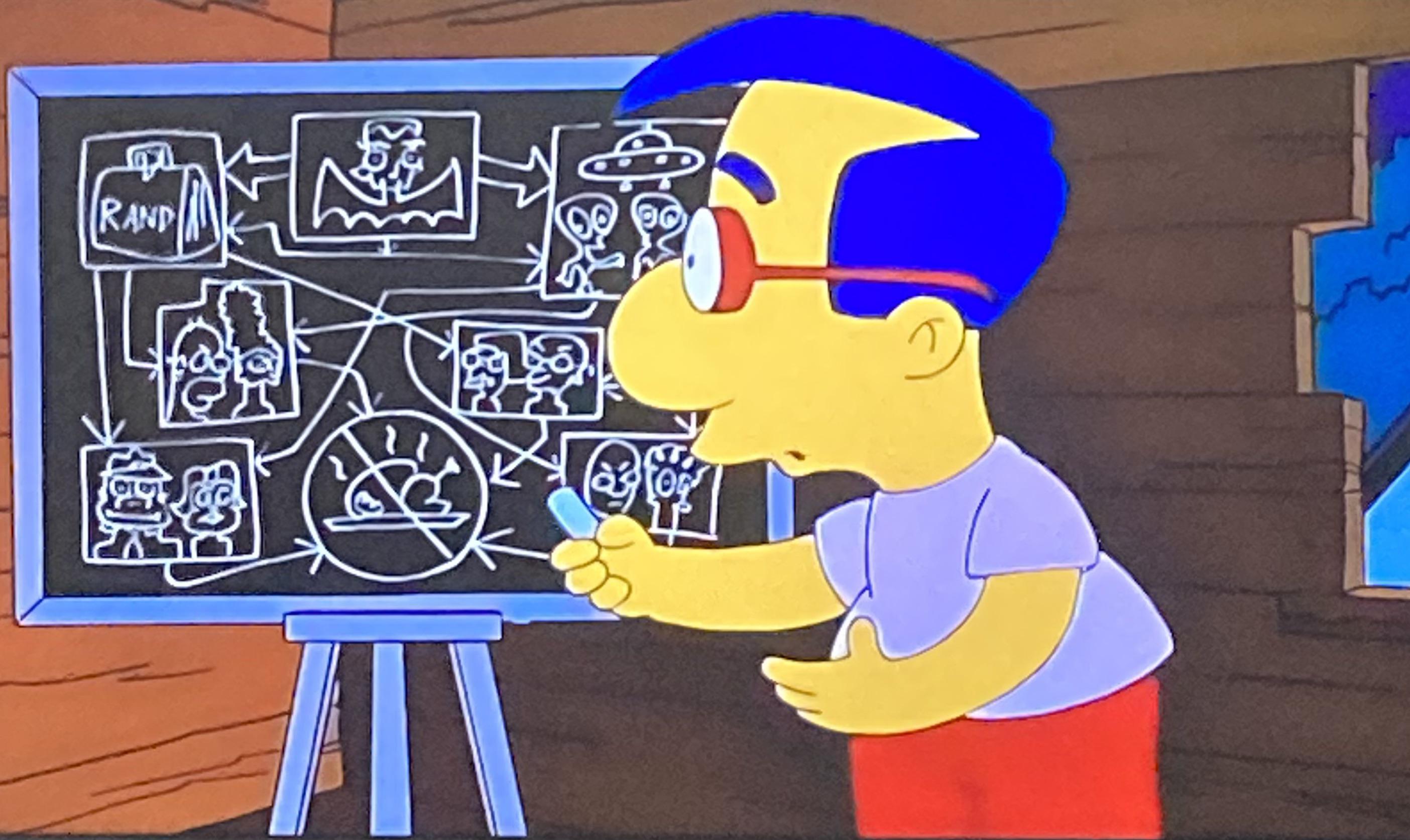
Why is this kind of conspiracy theory so attractive to a certain kind of aggrieved individual? Because the reality of the situation is even more terrifying. Especially in modern democracies, your country's leaders have been elected by popular vote. The people you see on the news really are the ones in charge. If they don't seem particularly competent, if they don't seem to have much of a plan, if your own life hasn't been improved by having elected them, you have no one to blame but yourself and your fellow voters.
This is the sociopolitical generalization of Jean-Paul Sartre's "man is condemned to be free". No one else is in charge. You elected those leaders who don't seem especially good at their jobs. You did this.
For many people, this reality is too much to take. They need another explanation. Something more comforting, something that removes this awesome responsibility and absolves them of their sins.
The competence vacuum
If the above explanation were true, we should expect interest in conspiracy theories to wax and wane with the competence of the people in charge. Times with more competent governance should see fewer and less-popular conspiracy theories, and times with less competence should be accompanied with a resurgence of crazy explanations for why things are as bad as they are.
Currently, competence appears to be in rather short supply across most Western democracies. Throughout Europe and the Americas, governments appear ineffectual, short-lasting, and only weakly representative of the full electorate. Their decision-making appears haphazard, lurching from crisis to self-inflicted crisis with nary a plan for the future. If you don't want to take my word for it, consider the OECD Trust Survey. It has documented a 2.4% decline in trust in national governments between 2021 and 2023 alone.
And indeed, into this competence vacuum have stepped a variety of conspiracy theories. QAnon was a big one for a while on the US right. Then various Epstein-related theories to explain the machinations of the current administration. There is no shortage of desire, yes thirst for explanations. Surely the people in charge can't be as venal, self-interested, corrupt and incompetent as they seem? And if they are, surely there's someone else who's actually running things?