
The Physical Embodiment Fallacy

In a lot of action/superhero movies, including the latest James Bond film No Time To Die, the villain's plan is pretty simple: design some terrible new superweapon, then use it to either blackmail world leaders, or to directly takeover the (checks notes), uh, world. The hero's plan is pretty simple too: find the evil supervillain's lair, kill the villain, and destoy the superweapon. Boom, problem solved until the next supervillain shows up. Right?
Wrong.
The economics of being a supervillain
Let's take a look at what goes on in a typical supervillain lair.
- Are they lone wolves? No, they typically have dozens or hundreds of people working for them.
And not just any people: scientists, computer experts, lawyers, accountants, a veritable army
of somewhat-less-evil-but-still-quite-evil and competent underlings. After all, it can't just be money that
convinces them to:
- leave their families,
- move to an uncharted island somewhere,
- work 24/7 on a project that has little chance of succeeding,
- and which is going to leave a pretty weird-looking hole in their resume if it doesn't work out.
- Yeah, the underlings are definitely pretty evil too.
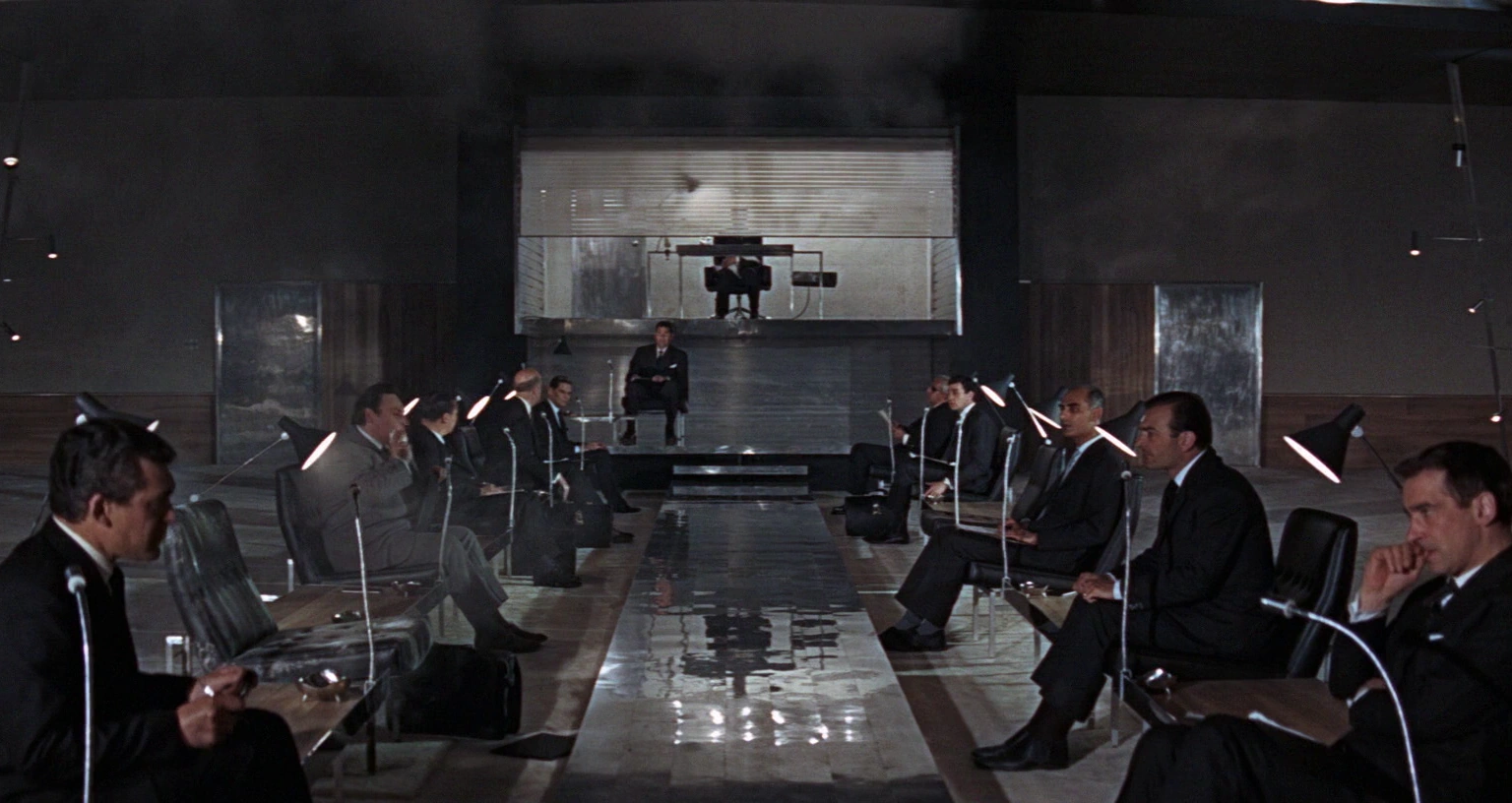
- Are they poorly financed? No, they typically have plenty of money to burn funding their
plans, which frequently take years or decades to bear fruit. They can even afford some pretty sweet
corporate offices:
- hollowed-out volcanoes,
- underwater mid-century-luxe mini-cities,
- a French château (twice),
- and plenty of others.
- Money definitely isn't tight in supervillain land.

Of course we're not talking about trillions of dollars or anything. Becoming a successful supervillain is hard, certainly, but the resource requirements are much lower than those a fairly large multinational could marshal. Let alone a nation-state, even a poor but ornery one like North Korea. But more on that in a minute.
The day after Bond's "victory"
It's worth looking into the situation right after the end-credits stop rolling, after Bond has had his roll in the hay with Ms. Double-Entendre-Name, after MI6 has successfully manipulated the press to ensure they don't report anything about what just happened. You know, reports about how close the world yet again came to total annihilation. Or something.
What happened to all of those fairly evil underlings? Did MI6 or the SAS swoop in and murder them?
What about the terabytes of files, experiments, machinery, the whole supply chain necessary to enable what was a pretty decently sized endeavor? Destroyed, burned, liquidated too?
Of course not.
If there's something we've learned about knowledge, it's that you can't put the genie back in the box once it's out. Once someone knows something important, and especially once a group of people know something important, that knowledge never gets un-known.
This is the Physical Embodiment Fallacy (PEF): the idea the value of knowledge resides in its physical embodiment, and that destroying the physical, epiphenomenal evidence of that knowledge destroys it.
Killing the villain and destroying his lair does nothing, in the long run. Even just the knowledge that a superweapon of a certain type is even possible is more than enough for other villains. Think of the hiring market for evil henchmen. I'm sure it exists. That dude who knows 80% of an operation that almost worked except for the incredibly lucky and heroic efforts of a British civil servant? He can name his price. I'm sure whoever is in charge of the Hermit Kingdom would love to have a word.
Just knowing something is possible is more than enough. In fact, just noticing what some people aren't saying is enough too! And this isn't just about theoretical superweapons though. The history of actual superweapon development gives us plenty of examples.
The hole in the research
Soviet nuclear physicist Georgy Flerov was a lowly lieutenant in the Soviet Air Forces during the Second World War. He's now somewhat famous because in 1942, he noticed that American, British and German scientists had completely stopped publishing papers about nuclear fission, a scientific subject which had been incredibly lively before the war. All of a sudden, bupkis.
Putting two and two together, Flerov, wrote a letter to Josef Stalin urging him to begin working on a uranium bomb. This letter eventually led to the development of the Soviet atom bomb project. Seven years later, starting from scratch and with a lot of very skillful spywork, they had a working bomb.
The same story repeated itself throughout the 50s, where US atom and H-bomb tests served as proof that something was possible, enabling the USSR and China to cut through decision-making uncertainty and move more quickly to catch up.
Of course, none of this is limited to weapons. In trading, famously, all you need to know is where a competitor is making money. Most of the time, just knowing which market is involved is enough to be able to reverse-engineer the strategies and profit potential.
The Physical Embodiment Fallacy everywhere you look
Once you understand this fallacy, you start to see it all over the place. Because it turns out most people, even very smart ones, need something you can actually physically touch in order to believe it exists and has value. Here are a few examples:
Competing against Nvidia by making better chips
In 2026, there is a small cottage industry of VC-funded startups trying to compete with Nvidia by making better AI chips. After all, if Nvidia is worth (gulp) $5 trillion, getting even 2% of Nvidia's market might mean a pretty respectable $100 billion market cap. They're trying it in all sorts of ways: inference only, analog memristor stuff, even some quantum craziness. The following prediction might age quite poorly, but I think they're all going to fail, or at best get bought for much less than 2% of Nvidia's market cap. Even ignoring the insane engineering difficulty of building a chip that can compete with Nvidia's offerings, the reason this is a tough business is that's it's not about the chips!
Nvidia's chips are the mere physical embodiment of an enormous vertical structure that underpins the use of the chips. And I don't just mean CUDA. I mean the system-level integration, the trust that Nvidia has built with customers for three decades, the ability to scale, all of it. The real value of Nvidia is not just that they can make chips no one else can, it's all of these other non-physical factors too. They're symbiotic, and building the chips alone will not help you unseat Nvidia.
The non-physical dominates the value
Precisely the same thing is true with Apple. The iPhone and Mac command significantly higher margins than their competitors because of the non-physical adjacent parts of the ecosystem. Yes the hardware is excellent, but Samsung and Huawei make equally good hardware. The differential value is in the non-physical: the App Store, the integration with Apple Music, Apple TV and their exclusive content, the precise way the AirPods connect and interact with your phone. You can't touch it, but it's just as real.
In the modern economy, the valuable stuff is never just the physical embodiment. Arrangements of atoms are easily copied. Chinese manufacturing has made a bit of a business of it, I'm sure you've noticed.
And yet, even in an economy where services account for 80% of GDP, most people have a "natural resources" mentality about what makes the world go round.
This fallacy helps explain why so many people have an anti-large corporation bias. Many people get oh so pissed off at large, profitable corporations being quite so large and profitable. But their ire is selective. For example, people seem mostly ok with large car manufacturers. But this makes sense under the Physical Embodiment Fallacy: it's very clear what car companies do. They take a bunch of raw materials and turn them into cars that people can touch, see, and buy. Even oil companies, though disliked for environmental reasons, are largely immune from "big opaque corporation" hate. Again, this is because it's clear what they do: they take dead dinosaurs out of the ground and sell them so that you can burn them.
But what the hell does Salesforce do that allows them to build the tallest skyscraper in San Francisco? Or the ever-hated investment banks? I sure can't see or touch their work product, so it must be fake, it must be a scam somehow. Where's the physical embodiment?
Maybe we should send in James Bond to destroy the printer where the credit card bills get printed. That'll fix the problem. Surely.
Fallacies in education
The same fallacy informs why so many modern education approaches suck at scaling. For example, consider the humble essay. Students have been assigned essay-writing for decades, even centuries, because for a long time the final result, physically embodied in "a hand-written essay" was a good signal that the student did the work. It was hard to fake, so the physical embodiment of "learning how to write a good essay" (i.e. the essay itself) was a sufficient thing to evaluate.
In the modern world, with easily accessible Web searching, AI computer assistance and other affordances, the final work product itself is no longer such a useful signal. It's easy to manufacture a school essay in a way that doesn't require the student to learn anything about writing a good one. But PEF is strong among teachers and school administrators, so the charade of essay-writing and essay-grading continues.
It also explains the school system's obsession with AI cheating detection software. "If only we can better evaluate the physical embodiment of the essay-writing learning process," they reason, "we will be able to evaluate students on that process." But again, the value is in the non-physical, somewhere in the brains of the students, so these approaches are destined to fail. When atoms are easy to manipulate, physical objects will never accurately represent any particular process by which those atoms were arranged into those objects.
Summary
- Information cannot be destroyed by destroying physical representations or evidence of that information's existence.
- In a highly developed society, the most valuable things can't be fully reduced to a physical representation.
- Manipulating atoms is usually easy, so very few arrangements of atoms will tell you anything useful about the process by which they were arranged.