
When Your Weird Hobby Takes Over the World (Part 4)
This is the fourth in a series of posts about my history with computers. I want to describe how it feels for your weird little obsession (computers) to end up taking over the world. Click here to read part 1.
I don't remember exactly when the Internet happened for me. What I do remember is that it felt like a logical progression of the stuff I had seen and tried before. In a very real sense, I didn't get the Internet until much later.
The progression
One day sometime in the late 80s, my dad came home with a modem. It was an expansion card that you plugged into the computer, into which you then plugged a phone jack. And if you had the right phone number to dial (local of course), you were rewarded with what I felt at the time was the most underwhelming computer experience possible. At 110 or 300 baud (yes, that's bits per second) you would see text frustratingly crawl across the row of your screen. At roughly 10 bits per character after all the framing overhead, you were looking at 10-30 characters per second. And for what? Some menu of boring choices on some bulletin board system (BBS)? The text your friend was typing in his house, a conversation centered exclusively around how "cool" this technology was? Indeed, my first experience with computer communications was decidedly meh.
By the early 90s, however, now transitioned to a 2400 baud modem and an IBM PC, the idea of BBSes started to gain some appeal. Specifically, the appeal of cracked games! My dad had always taken a dim view of turning computers into gaming stations, so the computer game budget at my house never quite matched my expectations. BBSes seemed like the gateway to get all the games I wanted. There was a catch though.
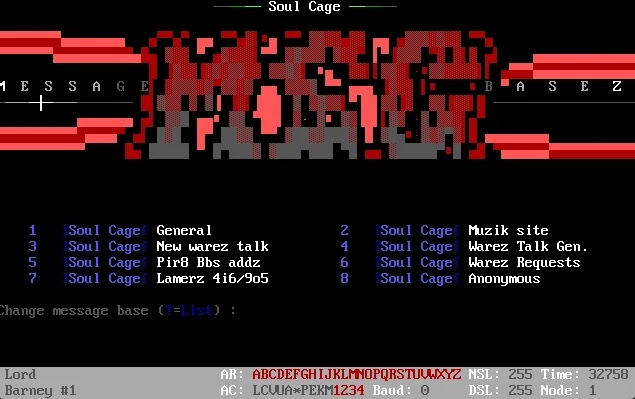
Specifically, the catch was that most BBSes operated on a give-to-get principle, where you needed to upload software you owned in order to get credits to download the software you wanted. And since the moral and ethical brain centers of a certain adolescent weren't yet fully formed, I saw no issue with packaging up and uploading everything I could get my hands on. This lasted until my dad caught me trying to bundle up his very expensive and very carefully licensed AutoCAD installation, which conclusively put an end to my dalliance with warez BBSes.
The next step in my education about computer networks was the Shad Valley alumni BBS. Nothing much happened there other than chatting. Lots of chatting. This was in 1992-1993, well before even AOL Instant Messenger existed. It may seem like a step back, going from downloading software to mere chatting, but in retrospect the key evolutionary step was that the people on that system weren't there because of the technology, the computers. They were there only because other people were there. Again, at the time this didn't seem like a big deal. At with most things, one only understands the sequence in retrospect.
The narrative you're reading flows forward in time. They invariably do, unless you're reading something avant-garde. The problem is that the narrative can only being written retrospectively. It's subject to my limited memory, of course, but more importantly it's framed by what I know and believe today. By attempting to construct a cohesive order and story to connect the otherwise-random occurrences of everyday life, I must necessarily be lying to you about the reality I lived in.
I say the above as a warning. The Internet was the most revolutionary technology in my lifetime (possibly to be superseded by AGI, if it happens), and so you'd be right to expect some insight about the nature of that revolution from someone who lived through it. At the risk of disappointing you, the only insights I have are the ones I've reconstructed from my memory and from what I now know is important. As always, caveat lector...
Logging on
As I recall it now, my first time using the Internet was through Telnet. The procedure seemed a bit odd, in fact. Unlike with a BBS, where you dial a number and that connects you directly to the server, using the Internet meant first connecting to a local server. In my case, this server was at the University of Western Ontario (now rather pathetically renamed "Western University" to erase any sense of its physical location), which was connected to my dad's work.
From that server and its alien Unix prompt, you could Telnet to other servers across the world. In practice "the world" meant American universities, many of whose names I knew for years after without even knowing where they were: WUSTL (with its wonderful wuarchive), UIUC, Princeton, Stanford. As we'll soon see, the Internet excels at erasing physical space. There wasn't much there, exactly, at least not for a high schooler. But the idea that there was a vast network of computers just sitting there with their stuff did seem pretty cool. No more logging into each BBS individually. One connection and you could touch them all.
I progressed to Gopher, FTP (with its inscrutable command line), and Usenet (a.b.p.e, IYKYK). All interesting enough, all text-based. That is, until the arrival of Trumpet WinSock, PPP, and the ability to run Mosaic, the very first Web browser.
I found the term "World Wide Web" unnecessarily long, hard to say, and with a terrible acronym. What kind of acronym has nine syllables? It sounded like the sort of term used by non-computer people to describe computer things. Maybe this should have been a signal about its importance, but as I've said before I was still oblivious to that.
The wonders of the early Internet
You've heard the old-timers say it, and it's true. The early pre-commercial, pre-social media Internet was a completely different world than today's version. I'm not arguing it was better back in the day, or anything like that. It was just very different. The sites you browsed, the information you obtained, was there because some individual person took the time to put it there. From a modern perspective, you could call it the artisanal Web: everything was custom, crafted, and there for enjoyment more than any other purpose. The things we laugh at today, and yes the things that were also annoying back then, like the animated multicolor backgrounds on personal webpages, did give it its character.
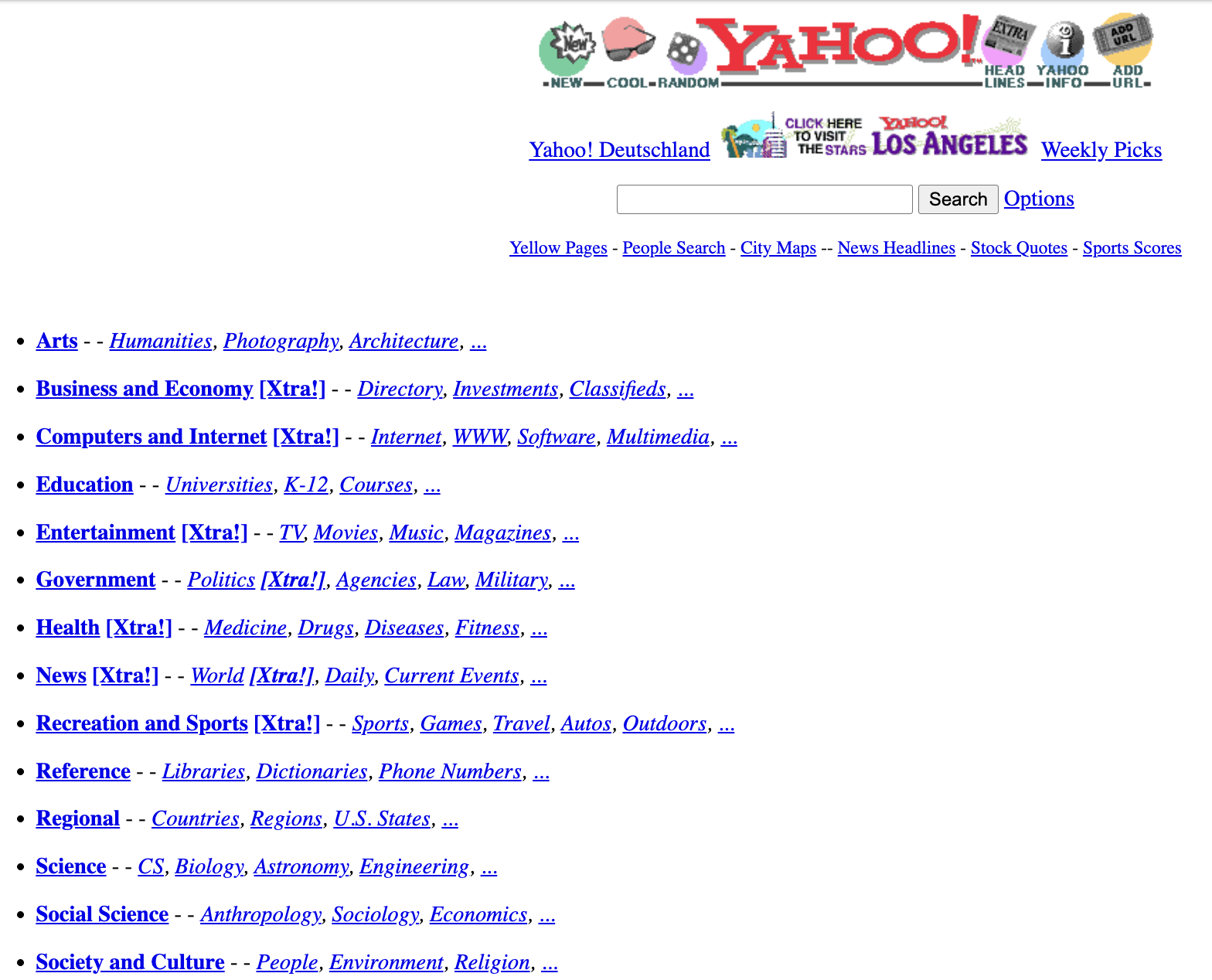
I remember spending hours trying to go down every branch in the Yahoo directory tree, even the things that didn't interest me at all. It was just about doable in the early 90s, a fact which seems utterly inconceivable today.
Rather quickly it became clear that, unlike the text-based Internet I was now used to, the Web was something different. A woman (!) with a Geocities page dedicated to pictures of roses, or a page dedicated to the memory of a teenager's friend who committed suicide. These weren't nerds, playing around on the Web because it's some cool new technology. No, the tech was completely secondary, almost irrelevant, merely a vehicle for the things they actually cared about.
Geocities itself was a concept both alien and familiar. It was an attempt to map the world onto the Internet, but instead of proximity being defined by geography, by location, it was defined by affinity. If what you cared about was lizards, you could find a "place" where everyone else also cared a lot about lizards. Vocation became location. Again, with modern eyes we can see this as such a natural evolution that we barely even notice it, let alone question it. We have to recognize the radical transition that it represented in how human relationships form. The world had to actually realize that on the Internet, nobody knows you're a dog.
And yet underneath the presentation and representation, there is still a human. Paging through thousands of personal websites you eventually come to a humbling realization. I finally did sometime in the late 90s. All of those thousands of websites, each individual and unique, are collectively representative of only a tiny fraction of the billions of lives being lived on the planet. It's one thing to learn in school about the population of the Earth. It's quite another to see it directly, in the vastness of the Internet, a place you could never hope to fully explore even if given a thousand lifetimes.
The transition to commercialization
The evolution of the Internet can be traced through many stages, and in my mind one website stands above the others as the avatar of those stages.
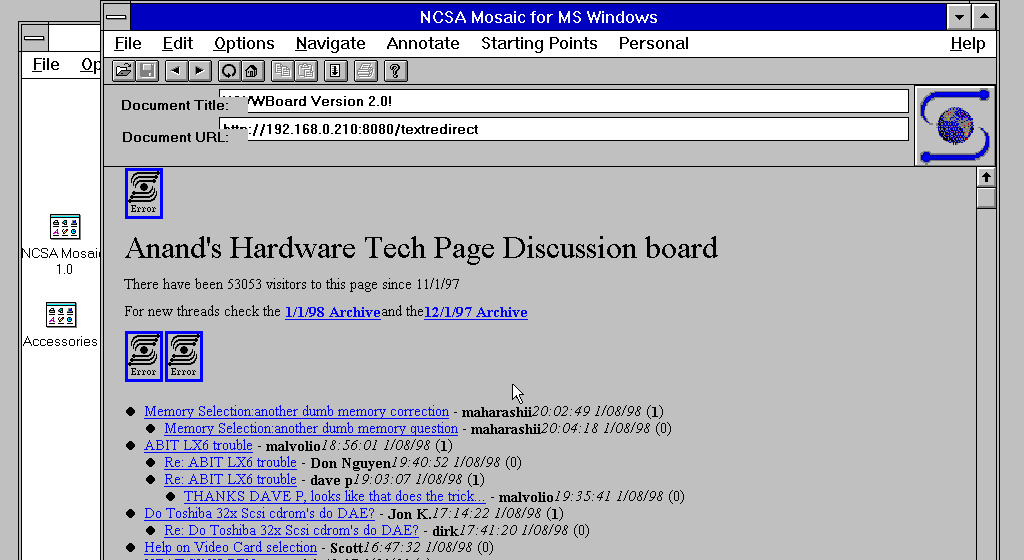
In the late 90s, the most useful and influential tech review website, for those in the know, was "Anand's Hardware Tech Page". It sounds precisely like what it was: a Geocities webpage where 15-year-old Anand Shimpi wrote and published detailed reviews of motherboards and other computer components. This wasn't a large commercial operation. It was simply a teenager's obsession with computers, displayed for the world to see and consume. Even though I was a bit older, I could empathize with Anand. He was one of my people, obviously someone who shared the same weird hobby. He didn't do it because it was cool, or because it was profitable. It was just... fun.
Fast-forward 8 years and AnandTech was receiving 50 million page views per month. It was the go-to location for honest, unbiased tech reviews. Its forums were populated by thousands of fellow enthusiasts, the company had employees, editors, senior editors, editors in chief. It was a full-fledged business. The evolution of AnandTech mirrored the evolution of the whole Web ecosystem. Personal pages were replaced by commercial ones, with gigantic and sophisticated ad targeting and delivery networks underpinning the traffic.
In retrospect it seems an inevitable transition. I mean, if the Internet started out free, who's going to go back to paying for it directly? But at the time it didn't seem inevitable. There were real debates about whether Internet commerce was really going to take off. Would people trust a website where you couldn't touch the product? Was rampant credit card fraud going to kill Internet commerce? It all got solved though. Boy did it get solved.
Computers are cool now
It was around this time that I started to figure out the Internet. What it was about. No longer just a useful tool, computers were now the way to connect to the Internet. Which is where everyone wanted to be. Sometime in university (1994-1999, studying computer engineering of course), I realized that computers and tech in general weren't a niche hobby anymore. It wasn't a particularly insightful realization, but the way the Internet swept away a whole culture in a matter of years, where now everyone was interested in the stuff that only a tiny fraction of us cared about a decade prior... it was disorienting.
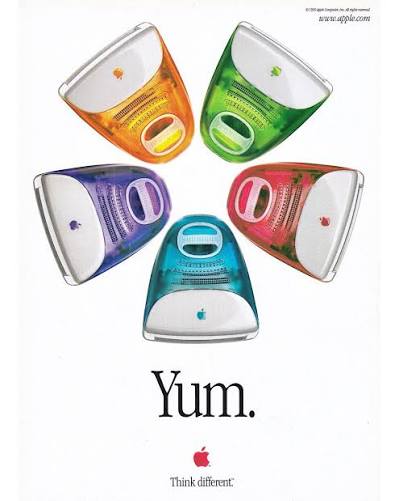
Everyone cared about tech now. Even the normies had an opinion. Computers were cool: they came in weird colors and had splashy mainstream ad campaigns. The launch of Windows 95 (an operating system!) was an international event that had Microsoft paying $3m for the rights to a song (Start Me Up by the Rolling Stones). The CN Tower in Toronto was even draped with a promotional banner. The stars of the biggest sitcom (Friends) were in the video guide!
Disorienting indeed. Many people like me hated it. They felt their hobby was being taken away from them. I admit I felt the same thing. Irrational pride at knowning a lot more about a subject I had been steeped in for over a decade whereas those others had just waltzed in last week. It didn't matter much that the knowledge I had carefully cultivated for all those years was now more valuable than ever. I mean, it would certainly matter over the course of the years and decades since, but at the time I just felt an overpowering urge to retreat into more and more esoteric corners.
The career choices of someone fleeing the crowd
Originally I went to university with the intent of getting a job writing software. And my first few internships were indeed software development jobs. But then "everyone" was learning how to write code. What's special about that? At the time, the dot-com bubble was in full swing and you couldn't turn around without finding someone who was writing code for some online retailer. I felt like some of my classmates were in my program just because it was either (a) hard to get into, or (b) a path to riches. To me they felt like interlopers and software in particular felt so... common, so ordinary.
So I got into hardware. Board-level design, internships at a video switching manufacturer, at RIM (the future Blackberry), but even that wasn't esoteric enough. Pushing further into the corners of technology, I decided board-level hardware was still too accessible, so my last two internships were at a chip design company. Designing fast dual-port static memories for networking equipment.
Finally I went all the way, and went to grad school to become an analog and RF integrated circuit engineer. Even other hardware engineers called it "black magic". That's where I wanted to be. I loved it, to be clear, because it was esoteric and difficult and yes possibly lucrative, with the rise of mobile phones. With the benefit of hindsight, it's true that at least some of the motivation was trying to reclaim that feeling of weirdness and specialness that attached to my favorite hobby throughout the 80s and early 90s. When your little hobby takes over the world, it's going to get a little weird. And so it did for me.
What does it all mean?
At least, this is the story I tell myself today. I'm neither proud nor embarrassed by it, and it's been two decades since I came to terms with the fact that "everyone is into tech now". Being "into tech" doesn't define me anymore, even though the satisfaction of knowing a lot more than most about it surfaces every once in a while. Knowing more than most about the most important tech of the moment has worked out pretty well, but I know I'd have done things roughly the same way if it hadn't.
In many respects I'm still the 4-year-old in the 3rd bedroom of our little townhouse, trying to make the star on top of the ASCII tree twinkle. And that feeling has never gone away.